
Quantum Computers Just Crossed the Threshold That Makes Them Actually Useful
The reversal that changes everything: for 30 years, bigger meant noisier. Now bigger means cleaner.
For three decades, quantum computing researchers faced a cruel paradox. To make quantum computers work, you need more qubits. But every qubit you add introduces more noise, more interference, more errors. It was the fundamental reason why quantum computers had remained small, temperamental, and scientifically interesting but practically useless – trapped in what researchers called the “NISQ era,” for Noisy Intermediate-Scale Quantum. You couldn’t scale up. The system would choke on its own complexity.
Then, in December 2024, Google published something that looked small on paper but represented the culmination of 30 years of theoretical work: proof that you could do the opposite. That a quantum computer could get quieter as it got bigger. That the error correction threshold – the crossover point where quantum error correction actually reduces errors faster than it introduces them – was not a mathematical fantasy but an engineering reality.
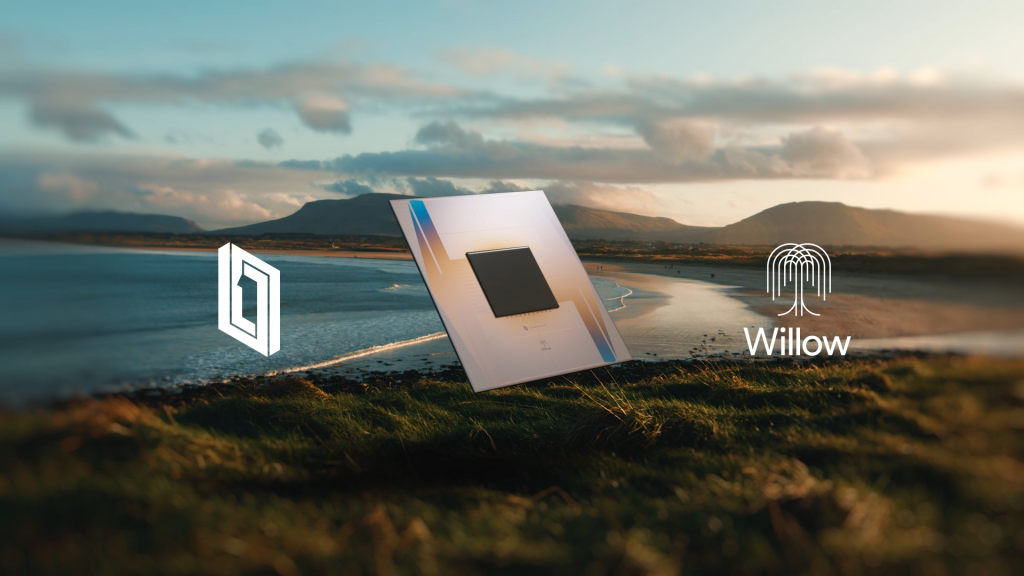
Google’s Willow chip demonstrated exactly this. As researchers expanded their array of logical qubits from a 3×3 grid to a 5×5 grid to a 7×7 grid, the error rate dropped exponentially. The larger system was more stable, not less. And this single fact – this inversion of everything that made quantum computers impractical – signals the beginning of the end of NISQ. The age of useful quantum computing is now in sight.
The 30-Year Threshold
To understand why this matters, you need to understand what makes quantum computers so fragile. A classical bit is either 0 or 1. A quantum bit, or qubit, exists in a superposition – both 0 and 1 simultaneously, until you measure it. This superposition is where quantum computers get their power: a system of N qubits can represent 2^N possible states at once. One hundred qubits can hold 2^100 different configurations in superposition, a number with 30 zeros.
But superposition is unstable. Any vibration, any electromagnetic noise, any thermal fluctuation can collapse the qubit from “both” back into “one or the other.” The qubit decoheres. The quantum advantage evaporates.
For decades, the solution seemed obvious: use multiple physical qubits to encode a single logical qubit – a qubit protected by redundancy. If you spread one logical qubit across, say, five physical qubits in a clever pattern, then a single error won’t destroy the data. The system can detect the error, diagnose it, and correct it without ever knowing what the original information was.
This is quantum error correction, and theoretically it’s sound. But there’s a hidden cost: to correct errors, you need to measure the system frequently. Measuring introduces its own errors. You’re constantly adding qubits to correct for measurement errors and the noise those measurements create. The overhead grows. And crucially, for quantum error correction to actually reduce your error rate, you need your base physical qubits to be very, very good. Good enough that the error you add through correction is smaller than the error you’re correcting. This crossover point – the threshold – seemed perpetually out of reach.
Google’s Willow changes that. It reached below-threshold operation.
What Google Actually Did
Willow is a 105-qubit superconducting quantum processor. It’s not fundamentally new technology – Google has been building superconducting qubits for years. What’s new is the qubit quality and the proof that error correction works.
Willow’s physical qubits have a coherence time of 68 microseconds, up from around 20 microseconds in Google’s previous Sycamore chip. That extra time is crucial – more time before a qubit decoheres means more time to perform operations and corrections.
But the real breakthrough is experimental and mathematical. Using surface codes – a type of quantum error correction code arranged in a 2D grid – Google’s team encoded logical qubits of increasing size. They started with a 3×3 grid of physical qubits representing one logical qubit. Then a 5×5 grid for a logical qubit. Then a 7×7 grid.
Each time they scaled up, the error rate per cycle dropped. Roughly by a factor of 2.14 when doubling the code distance. That exponential decline is what “below threshold” means. You cross from a regime where error correction makes things worse (adding noise faster than removing it) into a regime where it makes things better.
The final result: a 101-qubit distance-7 code with a logical error rate of just 0.143% per error correction cycle. That’s low enough to sustain meaningful quantum computation.
What This Unlocks
For practitioners, this is the signal they’ve been waiting for. It means the path forward is clear: build better qubits, implement proven error correction codes, and trust the exponential curve. Errors don’t scale catastrophically. You can actually build bigger quantum computers.
Practically, this opens several timelines:
In the next two years (2026-2027), expect quantum computers with 100 to 1,000 logical qubits. These won’t be general-purpose machines. Instead, they’ll be quantum simulators – specialized systems for modeling molecular and materials behavior. Pharmaceutical companies will use them to simulate how new compounds fold and bind. Materials scientists will model how to make better catalysts, batteries, superconductors. These aren’t theoretical gains; they’re computational wins over classical methods.
By 2030, quantum systems will tackle problems in cryptography, optimization, and machine learning where quantum advantage is most obvious. Some of this work will be economically valuable – shaving months off drug discovery, finding new materials, optimizing complex supply chains. Governments will start taking quantum cybersecurity seriously (post-quantum cryptography standards are being finalized now).
Beyond 2030, the horizon expands: artificial photosynthesis, nuclear fusion reactor design, biological simulation at scale. These are further out precisely because they require more qubits and higher error rates than we’ll have in 2026. But the path is no longer theoretical. It’s engineering.
The Competitive Landscape
Google isn’t the only player. The threshold has become a race.
IBM announced its Quantum Loon processor in November 2025, demonstrating all the hardware components needed for fault-tolerant quantum computing – about one year ahead of schedule. IBM is shifting its error correction strategy from surface codes to LDPC (low-density parity-check) codes, which promise lower overhead.
Microsoft and Atom Computing are partnering to deliver error-corrected quantum computers in 2026. They’re pursuing a different qubit type – neutral atoms trapped in optical tweezers – which may eventually have lower intrinsic error rates than superconducting qubits.
QuEra Computing, working with researchers at Harvard, MIT, and Yale, resolved fundamental barriers to fault tolerance in 2025 and demonstrated continuous error correction and magic state distillation. Their roadmap promises 100 logical qubits by 2026.
Iceberg Quantum unveiled Pinnacle, a full fault-tolerant quantum computing architecture based on LDPC codes, claiming an order-of-magnitude reduction in hardware overhead compared to surface-code designs.
The competition is fierce because the scale-up is exponential. Whoever demonstrates robust 1,000-qubit systems first – with error rates compatible with useful algorithms – wins both the scientific credibility and early access to industrial customers.
Why This Moment Matters
The error correction threshold has been the fundamental barrier to quantum utility since quantum computers were proposed. Theoretically, physicists knew it should exist. Experimentally, reaching it was a 30-year gap between theory and proof.
Closing that gap changes the entire narrative. Quantum computing moves from “Is it possible?” (answered decades ago) to “How fast can we scale it?” That’s an engineering problem, not a physics problem. It has a solution set.
What Google’s Willow, IBM’s Quantum Loon, and QuEra’s demonstrations prove is that quantum error correction works. Not as a theoretical curiosity. As an engineering tool you can use right now to build better quantum computers. The threshold is real, it’s reachable, and the exponential curve is on your side.
For the first time in quantum computing’s 40-year history, the only barrier left is engineering speed and capital. Not fundamental physics. That’s why every major tech company, dozens of startups, and government research agencies are pouring money into this space. They all see the same thing: the threshold has been crossed. Practical quantum advantage is no longer a question of if, but when.
The NISQ era is over. The next chapter has begun.
Sources
- Google Quantum AI, “Meet Willow, our state-of-the-art quantum chip,” Blog, December 9, 2024
- Nature, “Quantum error correction below the surface code threshold,” December 2024
- Quanta Magazine, “Quantum Computers Cross Critical Error Threshold,” December 9, 2024
- IBM Newsroom, “IBM Delivers New Quantum Processors, Software, and Algorithm Breakthroughs on Path to Advantage and Fault Tolerance,” November 12, 2025
- IEEE Spectrum, “Neutral Atom Quantum Computing: 2026’s Big Leap,” 2026
- Iceberg Quantum via Globe Newswire, “Iceberg Quantum unveils breakthrough in fault-tolerant quantum computing,” February 13, 2026
- DOE Office of Science, National Quantum Information Science Research Centers
- Riverlane, “Quantum Error Correction: Our 2025 trends and 2026 predictions”