
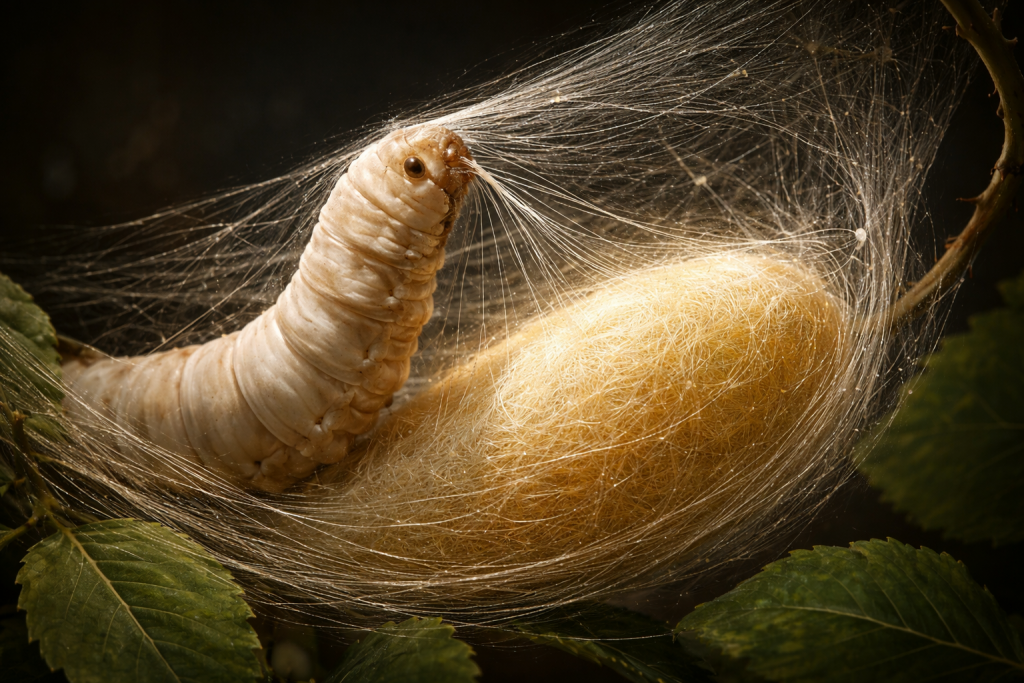
After 40 Years of Hype, Spider Silk Is Finally Being Made at Scale — and It’s Stronger Than Steel
Scientists have promised revolutionary spider silk for decades. Now Kraig Biocraft Laboratories is actually delivering it.
For forty years, spider silk has been “five years away.”
In the 1980s, researchers isolated the genes that give spider silk its extraordinary properties—a strength-to-weight ratio five times better than steel, yet flexible enough to stretch to twice its length before breaking. The promise seemed obvious: revolutionize textiles, create unbreakable armor, fabricate medical sutures that would never fail. Science journalism ran with it. Every few years, a new company would announce a breakthrough. Every time, the timeline was the same: commercial production in five years.
It never came.
Spiders, it turns out, cannot be farmed. They are territorial and cannibalistic, each one requiring its own enclosure. Genetic engineering offered a workaround—insert spider genes into silkworms, which are already cultivated in massive numbers—but for decades, the technology remained stubbornly unviable. Yields were abysmal. Costs were prohibitive. Production never scaled beyond the laboratory.
Until now.
On February 17, 2026, Kraig Biocraft Laboratories officially moved from strategy to execution. The company began incubating its proprietary spider silk silkworms and launching a multimillion-dollar scale-up initiative. The goal: 10 metric tons of recombinant spider silk cocoons per month by May 2026. Three industrial-scale silkworm rearing facilities are operational. National Geographic featured the company’s breakthrough on its March 2026 cover. Balenciaga has already announced its first spider silk fashion collection for Spring 2026.
After four decades of hype, spider silk is finally entering the real world.
The Problem That Seemed Unsolvable
The appeal of spider silk is straightforward: it combines properties that steel cannot. Tensile strength comparable to high-grade alloys, but at a fraction of the weight. Elasticity that allows it to absorb impact without breaking. Toughness that exceeds Kevlar. The evolutionary advantage is clear—orb-weaver spiders produce dragline silk strong enough to catch insects moving at 40 mph.
But spider silk also seemed impossible to manufacture at scale.
Early genetic engineers in the 1980s and 1990s identified the genes responsible—particularly MaSp1 (Major Ampullate Spidroin 1)—and understood that transferring them to a domesticated organism could, in theory, solve the farming problem. Silkworms have been cultivated for over 5,000 years. They are docile, efficient at converting plant matter to protein, and their glands naturally extrude fiber. They seemed like ideal biological factories for spider silk.
The problem was precision and yield.
Early attempts to insert spider genes into silkworm genomes used a genetic tool called PiggyBac—a transposable element that acts like molecular scissors, cutting into DNA and inserting new genes. The technique worked, but imprecisely. The genes that were inserted were often truncated, producing only partial spider silk proteins. The silkworm glands, evolved over millennia to produce conventional silk, were inefficient at expressing these foreign genes. The result was hybrid cocoons: mostly silkworm silk with tiny percentages—often less than 2%—of spider silk mixed in.
That 2% was transformative for the fiber’s properties—even small additions of spider silk made the overall cocoon tougher and more elastic. But the cost was astronomical. Early recombinant spider silk commands prices of $100,000 per kilogram. No textile, no medical device, no commercial application could justify that expense.
For three decades, companies struggled with this bottleneck. Kraig Biocraft, founded in 2007, published impressive research. Spiber Inc., a Japanese startup, produced lab samples that appeared on magazine covers. Bolt Threads, a California company backed by $213 million in investment, took a different approach—using yeast fermentation to produce spider silk proteins in vats rather than in silkworms.
None of it scaled.
The Technology That Finally Worked
The breakthrough came from an unexpected place: a gene-editing technology that had been perfected for research, not for agriculture.
CRISPR/Cas9, developed in the 2010s, revolutionized genetic engineering. Unlike older techniques that cut and inserted genes crudely, CRISPR is precise. Scientists can target exact locations in a genome, delete specific sequences, or insert new genes with minimal collateral damage. For spider silk production, CRISPR enabled something that PiggyBac could not: the insertion of full-length MaSp1 genes, producing complete, functional spider silk proteins rather than fragments.
The results were striking. Researchers at universities and biotech firms discovered that silkworms modified with complete spider silk genes produced cocoons with 50–64% spider silk protein yields—a twenty- to thirty-fold improvement over earlier attempts. The hybrid fibers were not merely stronger; they were demonstrably transformed. Strength improved by up to 40%. Elasticity doubled. Toughness increased by a factor of two.
Equally important, CRISPR made the process manufacturable. Genetic engineers could now refine the production reliably, optimize protein expression in silkworm glands, and maintain stable transgenic lines across multiple generations. The technology shifted from laboratory curiosity to industrial process.
Kraig Biocraft applied this knowledge ruthlessly. The company developed proprietary strains of genetically modified silkworms with optimized spider silk gene constructs. They built three massive rearing facilities—industrial-scale operations that house millions of silkworms. Each facility includes climate control, automated feeding systems, and harvesting protocols refined through thousands of cocoon batches. The company’s scientists and engineers solved problems that academia had not bothered with: silkworm mortality in large populations, cocoon consistency, protein expression stability across generations, continuous-cycle production.
By late 2025, Kraig Biocraft had sufficient confidence to announce an aggressive timeline. The company took possession of its third rearing center in January 2026. In February, it deployed its stockpile of proprietary silkworm eggs across all three facilities. In early March, the incubation began.
The 10 metric tons per month production target sounds impressive. In context, it is revolutionary. For four decades, global recombinant spider silk production was measured in grams. Kraig Biocraft is targeting 120 metric tons per year—a scale that enables commercial applications that were previously impossible.
What Comes Next
The first products featuring recombinant spider silk are already in production.
Balenciaga announced in early 2026 that its Spring collection would include garments woven from engineered spider silk. The luxury fashion house has not revealed pricing, but industry analysts expect starting points around $2,000–$5,000 per item—a premium justified by the material’s rarity, prestige, and superior performance characteristics. The garments are expected to be lighter, more durable, and more weather-resistant than conventional textiles.
Beyond fashion, the applications accelerate. Medical device companies are in clinical trials for spider silk sutures and wound dressings. The material’s biocompatibility and strength-to-weight ratio make it ideal for surgical applications. Military and law enforcement agencies are exploring body armor and protective gear that would combine spider silk’s impact absorption with its minimal weight penalty. Aerospace engineers are designing aircraft components from spider silk composite materials—structures that are simultaneously lighter and stronger than conventional carbon fiber.
The environmental case is compelling. Spider silk production using genetically modified silkworms requires no boiling cocoons (unlike conventional silk, which involves thermal killing), relies on renewable resources (silkworms eat mulberry leaves), and produces minimal chemical waste compared to petroleum-based synthetics or aramid fibers like Kevlar. As production scales and costs drop—analysts predict prices will fall to $5,000–$10,000 per kilogram within five years—the economics will favor spider silk over conventional materials for an expanding range of applications.
The market potential has attracted attention. Beyond Kraig Biocraft, other companies are racing to commercialize spider silk. Bolt Threads continues refining its yeast fermentation approach. AMSilk, a German biotech firm, has partnerships with luxury brands and is exploring industrial production. The competition itself signals that the market believes the technology has finally matured.
Why This Time Is Different
Skeptics have reason for caution. The history of spider silk is littered with bold promises that did not materialize. But the current moment differs in several critical ways.
First, the genetics are mature. CRISPR/Cas9 technology is no longer experimental; it is routine. Scientists have the tools to produce functional spider silk proteins reliably. The biology is understood.
Second, the infrastructure exists. Silkworm farming is not a new technology requiring development. China produces over 100,000 metric tons of silk annually. Scaling transgenic silkworm production leverages an existing, proven agricultural system. Kraig Biocraft did not need to invent farming; it needed to adapt and optimize it.
Third, the business model is emerging. Balenciaga’s commitment represents validation from the most demanding segment of the market. Luxury fashion moves at glacial speed; a major house does not announce a collection using experimental materials. The agreement signals confidence that spider silk can be produced reliably at commercial scale. Other customers will follow.
Fourth, the cost curve is favorable. Unlike some biotechnology breakthroughs that hit plateaus due to thermodynamic constraints, spider silk production costs are falling. Yields are improving. Operational efficiency is increasing. At $100,000 per kilogram, spider silk had zero commercial applications. At $1,000–$5,000 per kilogram (the expected range within 3–5 years), applications multiply. The unit economics are becoming viable.
Finally, there is a plausible answer to the question that has haunted the field: why now? The answer is not a single breakthrough but a convergence. CRISPR matured at the same time that investors developed patience with biotech timelines. Infrastructure investment in rearing facilities happened as the regulatory pathway for genetically modified animal products became clearer. Customer interest emerged as the fashion industry confronted sustainability concerns and performance demands. The moment required all these pieces; now, suddenly, they have aligned.
The Bigger Picture
For decades, synthetic biology operated as a perpetual promise—a field that would revolutionize manufacturing but always seemed five years away. Spider silk was the emblematic example: scientifically understood, commercially desirable, technologically feasible, yet somehow impossible to actually produce at scale.
Kraig Biocraft’s ascent suggests that might finally be changing. The company is not claiming miracles; it is simply making spider silk the way thousands of companies make conventional silk, but with a genetic modification that improves the end product. The innovation is not in the biology but in the execution—taking knowledge that existed for decades and finally, patiently, building the infrastructure to turn it into product.
If Kraig Biocraft succeeds at even a fraction of its stated targets, it will prove something important: that synthetic biology can graduate from laboratory to factory floor. That 40-year-old promises can materialize. That the problem was not whether spider silk could be made, but whether anyone would finally bother to make it at scale.
The answer appears to be yes. And this time, unlike the previous four decades, the evidence suggests it might actually be true.
Sources
- Kraig Biocraft Laboratories Activates First Wave of 2026 Production Program — GlobeNewswire, February 17, 2026
- Kraig Biocraft Laboratories’ Spider Silk Advancements Featured as the Cover of National Geographic’s March 2026 Issue — GlobeNewswire, February 23, 2026
- The quest to engineer silk that’s stronger than steel — National Geographic
- Genetically engineered silkworms with spider genes spin super-strong silk — National Geographic
- Spider silk is five times stronger than steel—now, scientists know why — Science Magazine (AAAS)
- Custom-designed, mass silk production in genetically engineered silkworms — PNAS Nexus, Oxford Academic
- Weaving Textiles from Recombinant Spider Silk — Genetic Engineering & Biotechnology News
- Balenciaga 3D-Weaves Spider Silk, Sparks Retail Revolution for Spring 2026 — Sourcing Journal
- Microsilk by Bolt Threads: A bioengineered fibre inspired by spider silk — Circle Economy Foundation