
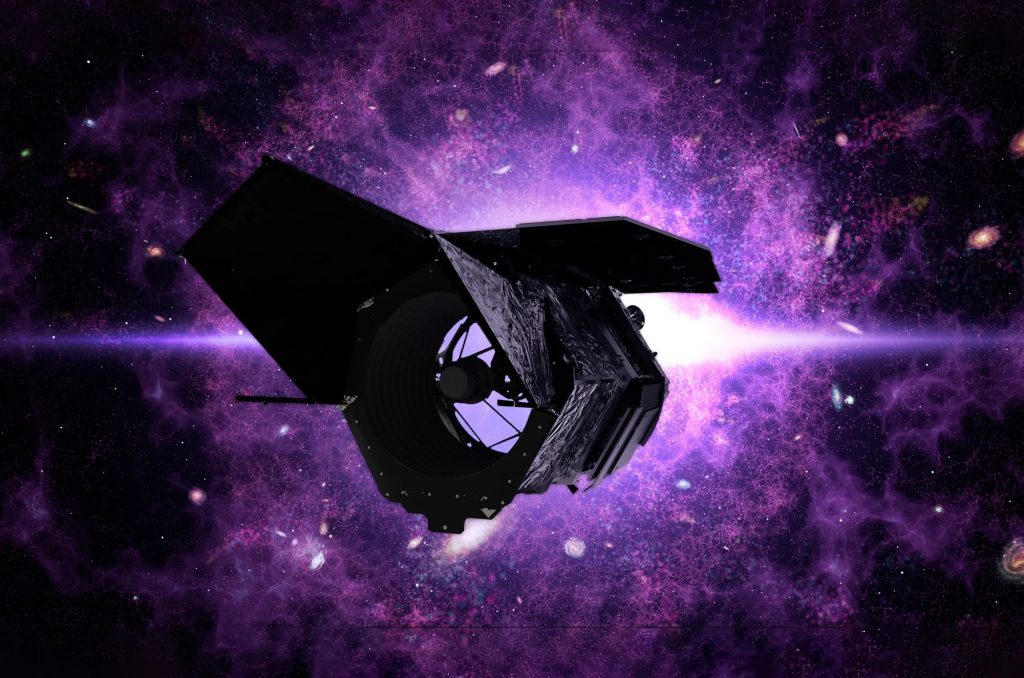
A New Space Telescope Launching This Year Could Take the First Photos of Worlds Around Other Stars
The Nancy Grace Roman Space Telescope, set to launch this September, will use a coronagraph instrument to directly image exoplanets in visible light—a capability never before demonstrated on a space telescope.
We’ve Found 5,000 Planets. We’ve Never Actually Seen One.
Imagine knowing your neighbor exists—really knowing, because you’ve seen the house vibrate slightly when they jump, caught glimpses of their shadow under the door, even measured the gravitational tug they exert on the ground beneath them—but never actually looking through the window. That’s where astronomy stands today.
In the three decades since the first exoplanet discovery in 1995, astronomers have confirmed the existence of more than 5,000 worlds orbiting distant stars. We know their sizes, masses, orbital periods, atmospheric compositions. We’ve even identified which ones orbit in their star’s habitable zone—the region where liquid water, and perhaps life, could exist.
Yet not a single one has been directly photographed around a sun-like star.
Everything we know comes from inference. Astronomers have become masters of reading cosmic clues—the wobble of starlight, the shadow of a transit, the warping of space itself—to confirm worlds we cannot see. But inference is not the same as sight. This year, that changes.
On a SpaceX Falcon Heavy rocket launching from Kennedy Space Center in late September 2026, NASA will send the Nancy Grace Roman Space Telescope toward its perch at Lagrange Point 2, roughly a million miles from Earth. Aboard Roman rides the Coronagraph Instrument, a technological leap that will, for the first time, block out the overwhelming glare of distant stars well enough to photograph older, colder, Earth-like worlds orbiting them.
The first direct images of an exoplanet system could arrive in 2027 or 2028. What we see could reshape how we search for life itself.
The Impossibility Problem: How Do You Photograph a Moth Next to a Stadium Floodlight?
To understand why exoplanet direct imaging is so phenomenally difficult, consider the numbers: a star is roughly 10 billion times brighter than the planets orbiting it.
From the perspective of a space telescope trying to photograph an exoplanet, it’s equivalent to standing in a parking lot at night, trying to photograph a moth perched directly in the beam of a stadium floodlight from half a mile away. The light overpowers everything. The moth is lost in the glare.
For decades, astronomers had only two tools for detecting exoplanets: the transit method and the radial velocity method.
The transit method works like this: a planet orbits its star. Every so often, from Earth’s vantage point, that planet passes directly in front of the star. The starlight dims—barely perceptibly. A star’s brightness might drop by just 1 percent when a Jupiter-sized planet crosses it; for an Earth-sized world, the dip is closer to 0.01 percent. But that tiny dip is detectable. Measure the depth and duration of the dip, and you can calculate the planet’s size and orbital period. By analyzing the star’s light during the transit, you can even infer what gases exist in the planet’s atmosphere.
The radial velocity method, which discovered the very first exoplanet (51 Pegasi b in 1995), works differently. As a planet orbits its star, the star is pulled slightly toward and then away from Earth. When the star moves toward us, its light blue-shifts (wavelengths compress). When it moves away, light red-shifts (wavelengths stretch). By measuring these shifts—the cosmic Doppler effect—astronomers can detect the planet’s presence and estimate its mass.
Both methods are elegant. Both have proven devastatingly effective: the transit method alone has found more than 70 percent of the known exoplanets. But both are indirect. They infer the planet’s existence from effects it has on starlight, never directly imaging the world itself.
Direct imaging—actually photographing the planet—has long been the holy grail. And until now, it’s been nearly impossible.
Why Direct Imaging Failed (Until Now)
Suppose you could somehow suppress 99.99 percent of a star’s light. You’d still have a 10-billion-times-brighter object in your image. Direct imaging of exoplanets worked, but only under one narrow condition: young, massive, hot planets far from their stars. These worlds, still glowing with heat from their formation billions of years ago, shine brightly enough to be seen against their star’s glare.
But young, hot Jupiters in distant orbits are rare and unrepresentative. Most planets, including potentially habitable worlds, are older and cooler. A planet like Earth—roughly the size of our world, orbiting in its star’s habitable zone—would be nearly invisible.
What exoplanet science needed was not incremental improvement but a revolution in starlight suppression.
Enter the coronagraph.
How Roman’s Coronagraph Will See the Unseeable
A coronagraph is a device that blocks starlight using optics rather than brute-force brightness. The original coronagraph, invented in the 19th century, was used to study the Sun’s corona during solar eclipses by artificially blocking the Sun’s disk.
Roman’s Coronagraph Instrument carries this idea forward with stunning sophistication.
The instrument uses a system of optical masks, prisms, detectors, and deformable mirrors—mirrors with thousands of tiny actuators that change shape in real time. Here’s how it works:
Light from a distant star enters the coronagraph. The deformable mirrors subtly reshape themselves to match the exact wavefront of that starlight. The optical masks then create destructive interference—they cancel out the star’s light photon by photon, the way two sound waves can cancel each other out if their troughs and peaks are perfectly inverted.
The result: starlight suppression by a factor of 100 million to 1 billion. It’s not perfect, but it’s revolutionary. For the first time, faint, cool exoplanets can shine through.
Roman’s coronagraph can directly image Jupiter-sized worlds orbiting sun-like stars at distances of a few astronomical units—roughly where Jupiter sits in our own solar system. It can observe planets billions of years old, not just newborns. And it’s designed to take this crucial first step toward imaging Earth-sized worlds in habitable zones, a capability that will be fully realized in NASA’s next flagship mission, the Habitable Worlds Observatory, expected in the 2040s.
The scale of improvement is staggering: Roman’s coronagraph is 100 to 1,000 times more powerful than any coronagraph previously flown on a space telescope.
Roman and James Webb: A Cosmic Partnership
You might wonder: James Webb Space Telescope is already in orbit. Why do we need Roman?
The two telescopes approach exoplanet science differently, and their differences make them complementary.
James Webb observes primarily in infrared. Its exquisite sensitivity allows it to detect the heat signatures of young, hot planets—worlds still glowing from their formation. Webb can analyze their atmospheres in detail, searching for chemical signatures. But Webb’s strength is depth: it peers deeply into space and through dust, but it surveys relatively small patches of sky.
Roman observes in visible light using its wide-field imaging capability. While its coronagraph focuses on direct imaging, Roman’s primary science instrument—the 300-megapixel Wide Field Instrument—will survey vast areas of the sky, cataloging millions of galaxies and thousands of exoplanets through traditional methods (transit and microlensing).
The coronagraph will identify exoplanet systems worth studying. Webb will follow up, analyzing the atmospheric composition of the most intriguing worlds.
In a sense, Roman is the scout. Webb is the analyst. Together, they expand what’s possible.
What a Photograph Would Mean
When we finally see a photograph of another world—a real image of a distant exoplanet, not a graph or an inference—something will shift in human consciousness.
A photograph is immediate. It’s proof. It shows not just that a planet exists, but what it looks like: atmospheric structure, cloud patterns, color, variations across its surface. From an image, we can extract spectra and search for biosignatures—chemical signs of life. Oxygen and methane together, for instance, would be a profound clue.
Perhaps most importantly, a photograph makes the search for extraterrestrial life empirical rather than philosophical. It transforms the question from “Could there be life out there?” to “What is the probability that this world, which we can see and study, harbors life?”
For the first time, we would know whether habitable-zone worlds are common (suggesting that biology might be a universal phenomenon) or rare (suggesting we are extraordinary).
The emotional weight is hard to overstate. Humans have spent millennia wondering if we’re alone. For the first time, we’ll have the tools to know.
The Timeline: Why This Year Matters
Roman launches in September 2026. After a journey of roughly one month, it will reach Lagrange Point 2, where Earth’s gravity and the Sun’s gravity balance. There, it will unfold—a complex choreography of deployments that will take weeks.
The coronagraph will undergo commissioning and calibration, a process typically lasting 6 to 12 months for space telescopes. By late 2027 or early 2028, we should see the first direct images of exoplanet systems.
From there, Roman will embark on a multi-year mission of discovery. The wide-field survey will find tens of thousands of exoplanets through traditional methods. The coronagraph will image the most compelling systems. Astronomers around the world will study the data, searching for atmospheres, mapping cloud formations, asking the question that has haunted us since we first understood that other stars held worlds: Is anyone home?
The Wonder Remains
For most of human history, the question “Are we alone?” was unanswerable. It belonged to philosophy and religion. Then, in 1995, we discovered the first exoplanet. The question became science.
Today, we know other worlds exist. Thousands of them. But we see them only through the distorting lens of inference.
In September 2026, Roman will launch. By 2028, we may hold in our hands the first photographs of another world. Not an inferred world. Not a shadow or a wobble or a spectrum. A photograph.
What we find could reshape the search for life, reframe our understanding of our place in the cosmos, and answer the oldest question we have ever asked.
The wonder, at last, will become sight.